
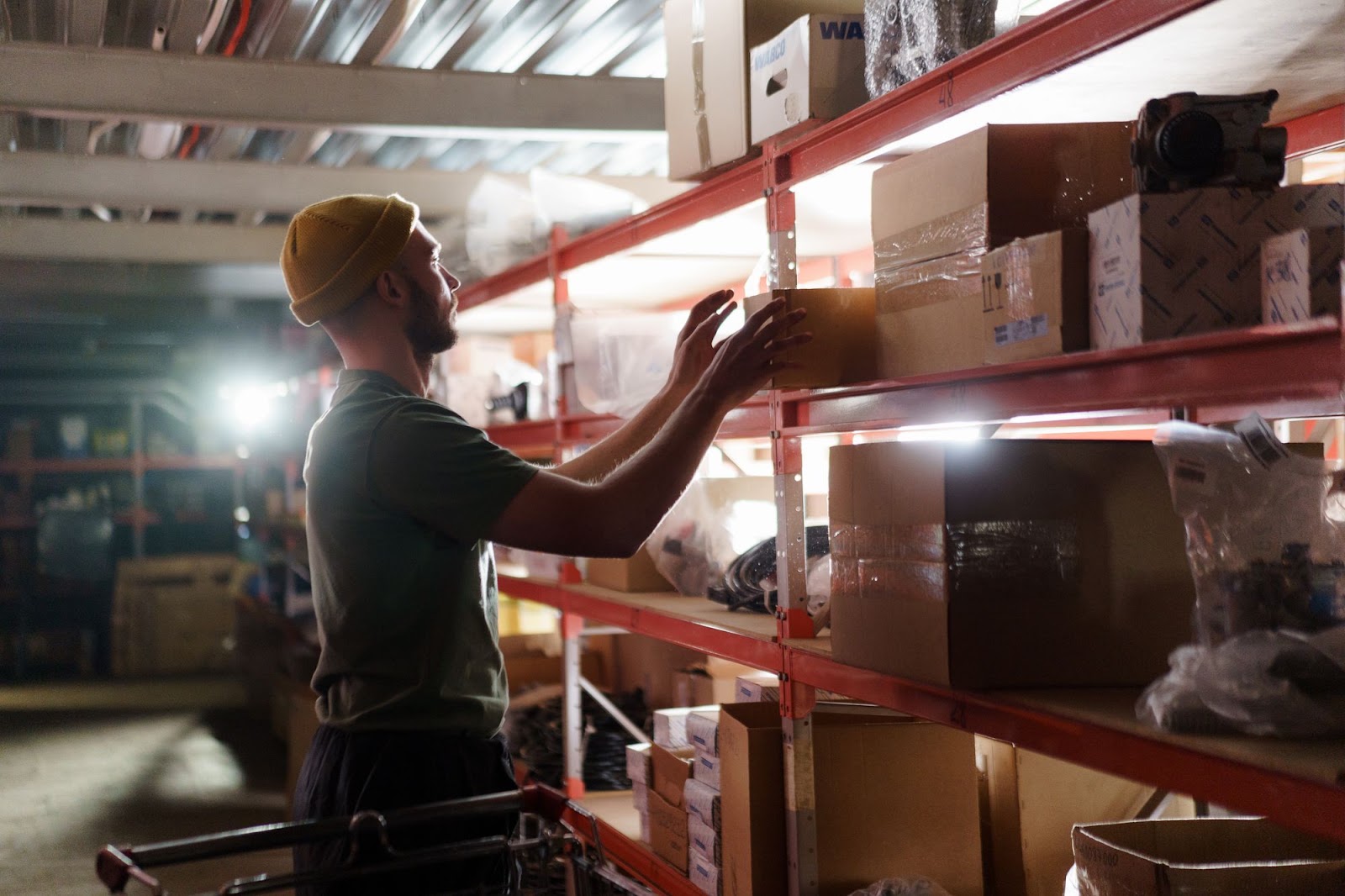
Your warehouse needs reorganising, your shop is being refurbished or your office premises must be vacated before a move. Commercial clearance is rarely just a matter of taking unwanted items away. Furniture may need to be retained, equipment transferred to another site and other materials removed. FFS can assess the practical requirements of clearing business premises in Belgium.
The premises must be cleared, but not everything is going
Consider a shop preparing for refurbishment. Contractors will need access to the sales floor, but the building still contains display units, shelving, stockroom furniture, boxes and various fittings.
Some items are intended for another branch. Others will remain in the building but need to be moved to a different area. A final group is no longer required.
The initial instruction might simply be, "We need the shop emptied." In practice, it involves several distinct tasks, each with its own destination and handling requirements.
The same situation can arise in a warehouse, a former retail unit, an office being relocated or an event space being cleared after use.
Start by deciding where everything belongs
Before planning the physical work, it helps to divide the contents into clear categories.
Keep on site: furniture or equipment that must be moved to another part of the building.
Transfer elsewhere: items intended for new premises, another branch or an external storage location.
Remove: unwanted objects or materials, subject to their nature and the available handling and disposal arrangements.
Clarify first: connected equipment, fixed installations, fragile items or anything whose destination has not yet been decided.
This approach reduces confusion during the operation. It also helps distinguish straightforward handling tasks from work that requires further technical assessment.
Before refurbishment: clear the areas that matter
A business does not always need to empty an entire building before renovation work begins.
Sometimes a particular wall, stockroom or section of the sales floor needs to be made accessible. In other cases, the whole premises must be vacated before the next phase.
The useful question is: which areas need to be free, and what condition must they be in for the following work?
A simple floor plan, photographs and a list of the main items can help define the request. It is also useful to identify any furniture that must remain accessible or any areas that should not be disturbed.
Relocation: separate what is moving from what is being removed
Business relocation often combines two operations that should be planned separately.
Workstations, cabinets, shop fittings or dismantled furniture may be intended for the new premises. Older or redundant items may need a different destination.
Imagine an office moving to a smaller site. The company wishes to retain its current desks but no longer needs several storage cabinets. Those items do not belong in the same transport plan.
Likewise, a retailer may transfer selected display units while clearing the remaining stockroom furniture.
Identifying these different flows early helps make the request easier to assess.
After a trade fair or event: making the space available again
At the end of an exhibition or business event, removing the display structure may be only part of the work.
There may still be furniture, presentation equipment, transport cases and other materials intended for different destinations.
Before arranging any handling or clearance, the organiser or exhibitor needs to identify what is being collected, stored or removed.
Venue access rules, loading arrangements and the nature of the equipment also matter. FFS can examine requests involving practical handling and space clearance without assuming that every operation or item can automatically be taken on.
What affects the organisation and quotation?
The floor area alone does not determine the amount of work involved.
The volume, weight and dimensions of the items matter, as do dismantling requirements, internal access routes, loading areas and the number of destinations.
A compact stockroom filled with bulky fixtures can require more preparation than a much larger, nearly empty space.
For an initial discussion, provide the site location, the areas concerned, an approximate inventory, photographs, access information and the intended result.
Identify fixed or connected equipment separately. Such items may require additional assessment before their handling can be considered.
The quotation depends on the scope agreed for the operation rather than simply on the square metres involved.
Preparing the premises for what comes next
A commercial clearance has a purpose beyond removing objects. The space needs to be ready for refurbishment, reorganisation, relocation or its next use.
That requires an understanding of the site, the destination of its contents and the work scheduled afterwards.
FFS approaches these requests by looking at the practical outcome the business needs to achieve.
Frequently asked questions
Can only part of a warehouse or stockroom be cleared?
Yes. The request can be limited to a defined area. Specify its boundaries and the items involved.
Can furniture be distributed between several locations?
Describe the destinations and approximate volumes. The feasibility and transport arrangements can then be reviewed.
Can clearance be organised before refurbishment?
Explain which areas must be made available and what access or site constraints apply.
What should I provide for an initial assessment?
Photographs, an approximate inventory, the site address, access details and the intended destinations of the main items.
Need to free up commercial space?
Tell FFS about your premises, the equipment involved and the objective of the operation. We can discuss the handling, transfer and clearance requirements relevant to your request.
Phone: +32 472 88 08 66
WhatsApp: Discuss your project on WhatsApp



No comments:
Post a Comment